

Concierge Medicine Guide
Is DPC the Same as Concierge Medicine? Direct Primary Care vs Concierge, Explained
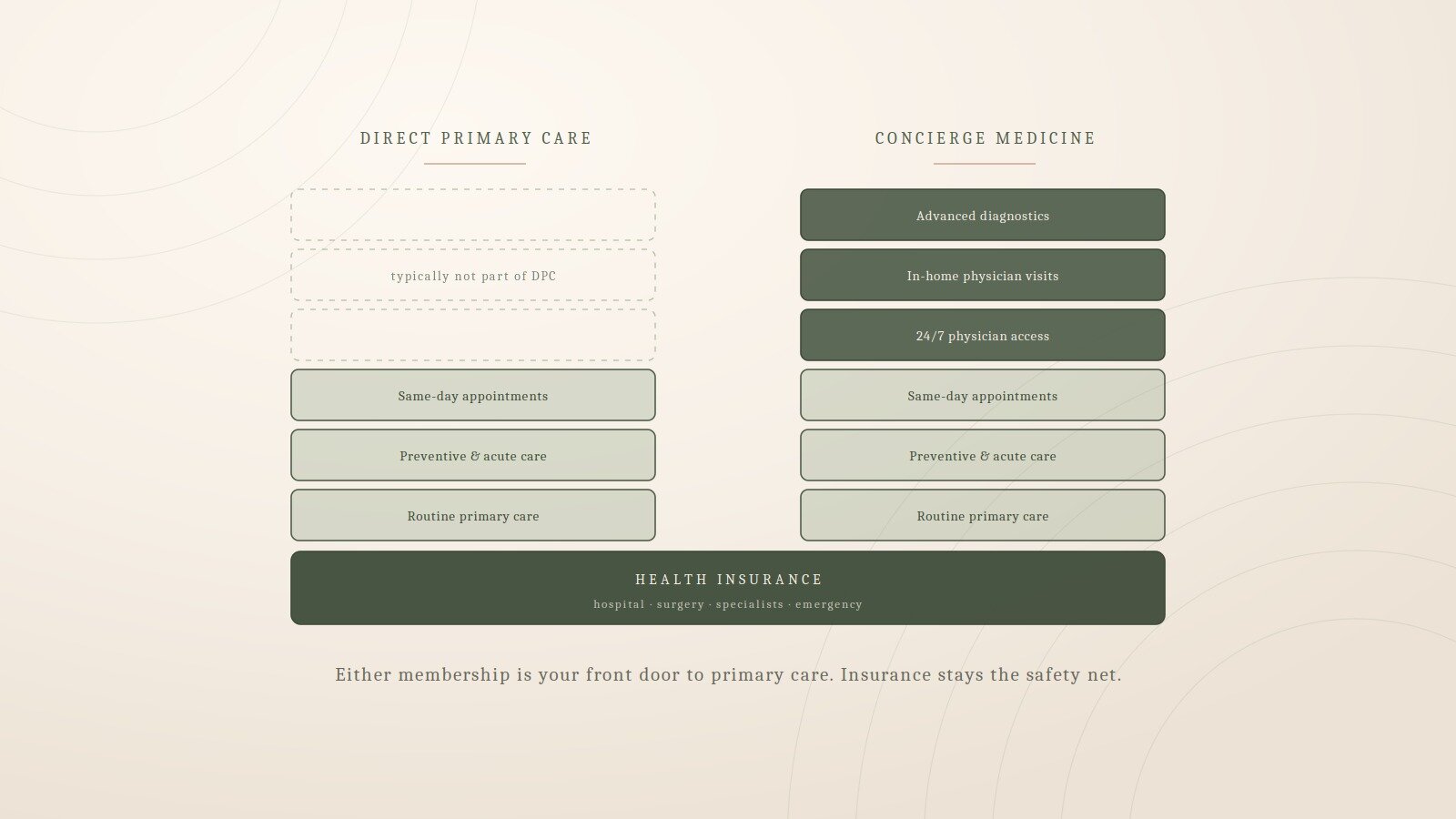
If you have started researching membership-based healthcare, you have probably seen direct primary care and concierge medicine used almost interchangeably. Both are membership models, and both let you pay a physician directly for better primary care access. Yet direct primary care and concierge medicine are two distinct models with different fees, different scope, and different patients in mind. This guide breaks down the difference between direct primary care and concierge medicine on fees, scope, and physician access, so you can decide which membership model actually fits your family and your budget.
The Short Answer: DPC and Concierge Medicine Are Not the Same
No, direct primary care and concierge medicine are not the same. Direct primary care (DPC) is basic primary care delivered for a flat monthly fee with no insurance billing, while concierge medicine is a broader, higher-touch tier of primary care that layers deeper physician access and advanced diagnostics on top of your existing health insurance. Both models replace the rushed, insurance-driven office visit with time and direct physician access, but direct primary care and concierge medicine sit at different points on the spectrum of care.
The simplest way to think about it: DPC changes how you pay for primary care, while concierge medicine changes how much medicine you actually receive.
Ready to see what physician-led concierge medicine looks like in practice? A short discovery call is the fastest way to compare direct primary care and concierge care side by side.
Direct Primary Care vs Concierge Medicine: A Side-by-Side Comparison
The clearest way to understand concierge vs DPC is to compare direct primary care and concierge medicine across the factors that matter to patients: what you pay in membership fees, what scope of primary care you get, and how you reach your physician.
| Feature | Direct Primary Care (DPC) | Concierge Medicine |
|---|---|---|
| Fee model | Flat monthly fee, roughly $100–$300 | Annual membership fee; surveys report a starting point near $4,000/year, rising substantially for comprehensive, in-home care |
| Insurance | Insurance-free; no copays on covered visits | Membership sits alongside standard insurance or Medicare |
| Scope of care | Basic primary care, preventive and acute care | Broader: preventive care, advanced diagnostics, specialist coordination |
| Access | Same-day appointments, longer visits, telehealth | 24/7 physician access, same-day and in-home visits |
| Patient panel | Larger, often 400–800 patients | Deliberately limited panel, often a small number of families rather than hundreds of patients |
| Who it fits | Cost-conscious individuals and families | Patients wanting proactive, time-intensive care |
One point the fee column hides: because a concierge membership is paid in addition to your insurance premiums, the true annual cost of concierge medicine is the membership fee plus what you already spend on coverage. Direct primary care, by contrast, is usually paired with a lower-cost catastrophic or high-deductible plan that covers hospital and specialist bills, so the flat monthly fee is closer to your total primary care spend.
What Is Direct Primary Care (DPC)?
Direct primary care is a primary care model where patients pay their primary care physician a recurring flat monthly fee, typically between $100 and $300, in exchange for unlimited access to routine primary care services. The defining feature of DPC is that it is insurance-free: the practice does not bill insurance for its own visits, which removes copays, insurance coding overhead, and much of the administrative friction of traditional fee-for-service medicine.
That flat membership fee generally covers preventive care, acute care for everyday illnesses, chronic disease management, and often basic labs and bloodwork at reduced cost. Direct primary care practices carry a larger patient panel than concierge practices, and they lean on same-day appointments, longer visits, and telehealth to keep the primary care physician accessible between visits.
Because direct primary care does not replace full coverage, most DPC members pair the membership with a separate insurance plan for emergencies and specialists. A few things to know about how DPC fits the wider system:
- Direct primary care is named in the Affordable Care Act (ACA) as an acceptable care arrangement when paired with a wraparound insurance plan.
- Many DPC members combine the flat monthly fee with a high-deductible health plan (HDHP) or catastrophic insurance for major costs.
- Employers increasingly offer direct primary care to give staff predictable, low-cost primary care with no copays.
What Is Concierge Medicine?
Concierge medicine is a membership model where patients pay an annual membership fee, which industry surveys place starting near $4,000 per year and rising substantially for comprehensive, in-home care, to a physician who keeps a limited patient panel and provides enhanced primary care access. Unlike direct primary care, most concierge practices still bill your insurance or Medicare for covered services, so the membership fee buys availability, time, and depth of care rather than replacing insurance coverage.
That depth is the real distinction between concierge medicine and direct primary care. Concierge members typically receive 24/7 physician access, same-day and often in-home visits, active specialist coordination, and advanced diagnostics such as imaging, labs, and biomarker analysis. The smaller patient panel is what makes this possible: fewer patients per physician means longer appointments, more attention for each patient, and genuine continuity of care across the year.
Concierge Care as a Clinical Tier, Not Just a Price Tier
The common misconception is that concierge medicine is simply direct primary care with a bigger bill. In practice, the stronger concierge medicine models expand what medicine gets delivered, not just what primary care costs. At Nivaan Health, that means a physician-led concierge practice built around 24/7 in-home physician care, where a doctor comes to you for urgent visits, pediatric care, and in-home diagnostics rather than routing every concern through an office.
It also means proactive medicine: advanced imaging, metabolic evaluation, biomarker analysis, and cardiovascular screening used to detect risk earlier instead of reacting to illness after it appears. That combination of direct physician access, deeper advanced diagnostics, and hands-on specialist coordination is what separates a clinical tier of concierge medicine from a simple pricing tier.
See how the concierge membership tiers translate that depth of care into a concrete plan for your household.
Do You Still Need Insurance With DPC or Concierge Medicine?
Yes, in almost every case you still need health insurance alongside either model. This is the single most important thing to understand before you join, because neither direct primary care nor concierge medicine is a substitute for comprehensive insurance coverage. Both models concentrate on primary care, and neither one pays for the services that generate the largest medical bills.
Here is what a direct primary care or concierge membership does not cover:
- Emergency room visits and ambulance transport
- Hospitalization and surgery
- Specialist procedures and the specialists' own fees
- Advanced treatments like chemotherapy or major imaging billed by outside facilities
With direct primary care, the standard approach pairs the flat monthly fee with a high-deductible or catastrophic insurance plan that catches those larger costs. With concierge medicine, your existing insurance or Medicare stays in place and the annual retainer sits on top of it. In both cases, the membership handles everyday primary care, preventive care, and specialist coordination, while insurance remains your backstop for major medical events.
Think of the membership as your front door to primary care and insurance as your safety net; you want both, not one instead of the other.
Which Model Is Right for You?
The right choice between concierge vs DPC comes down to how much care you want, how you prefer to pay, and how complex your health needs are. Here is a straightforward way to decide between direct primary care and concierge medicine.
Choose Direct Primary Care If…
You want predictable, low monthly costs
Direct primary care works well when your priority is affordable, transparent pricing. A flat monthly fee with no copays makes budgeting simple, which is why many families and younger patients start with direct primary care before they ever consider concierge medicine or a higher annual retainer.
You are generally healthy and need routine primary care
If your needs center on preventive care, everyday acute care, and basic chronic disease management, the direct primary care scope and same-day appointments cover most of what you use in a year without paying for the advanced diagnostics and specialist coordination a concierge membership adds.
You already keep major-medical coverage
Direct primary care fits neatly beside a high-deductible health plan or catastrophic insurance. If you already carry that wraparound insurance coverage, direct primary care adds accessible primary care, preventive care, and same-day appointments at a modest flat monthly fee.
Choose Concierge Medicine If…
You want 24/7 physician access and in-home care
Concierge medicine is built for patients who value reaching their primary care physician any time and being seen at home. If 24/7 physician access and same-day, in-home visits matter to your family, concierge medicine is the tier that delivers that direct physician access.
You are managing complex or chronic conditions
When care involves multiple specialists or ongoing chronic conditions, concierge specialist coordination, longer appointments, and continuity of care reduce the burden of navigating the health system yourself.
You value advanced diagnostics and specialist coordination
If proactive testing, advanced imaging, and biomarker analysis are part of how you want to manage your health, concierge medicine folds those advanced diagnostics into a single, physician-led primary care relationship.
If concierge-level access and diagnostics sound like the fit, a Nivaan physician can map out exactly what that looks like for you.
Ready to Move From Comparing to Choosing?
A brief discovery call with a Nivaan physician shows you exactly how concierge medicine would work for your family, with no obligation to join. You will see how 24/7 in-home physician access, advanced diagnostics, and specialist coordination come together in one concierge membership.
Frequently Asked Questions
Is DPC cheaper than concierge medicine?
Yes, direct primary care is usually cheaper than concierge medicine. DPC runs about $100 to $300 per month with no insurance billing, while concierge membership fees start higher, with surveys reporting figures beginning near $4,000 per year and climbing for comprehensive, in-home care. Concierge costs more because it adds broader access and advanced diagnostics.
Is direct primary care the same as a membership practice?
Direct primary care is one type of membership practice, but not every membership practice is DPC. The direct primary care label specifically means an insurance-free model with a flat monthly fee for primary care. Concierge medicine is also membership-based, yet it typically bills insurance alongside its annual retainer.
Does concierge medicine include house calls?
Some concierge practices include house calls, though many limit access to phone and office visits. Nivaan Health is built around in-home physician visits, with doctors traveling to patients for urgent care, pediatric visits, and diagnostics as part of the concierge membership.
How many patients does a concierge doctor take?
A concierge physician keeps a deliberately limited patient panel, far smaller than a traditional primary care practice. Many family-oriented concierge practices measure it in a small number of families rather than hundreds of individual patients, which is what allows longer appointments, same-day access, and continuity of care.


